

Week 1 · The Organic Diagnostic Plan
The question is not “should we do more marketing?”
It’s a better question, asked less often: where is growth actually getting stuck? More activity can hide the real problem — and sometimes it just sends more attention into a system that is already leaking.
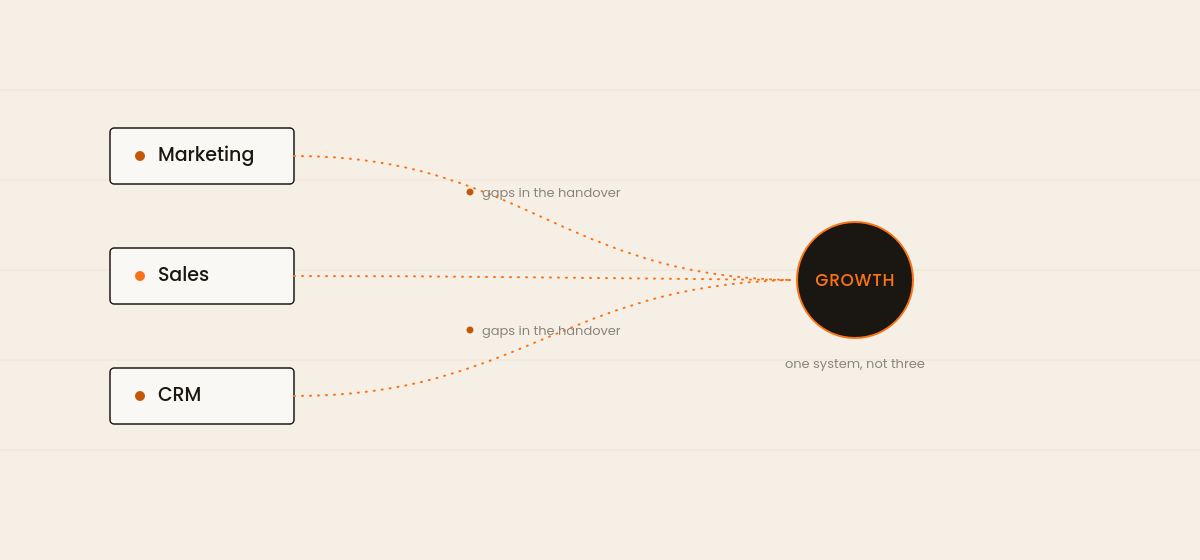
When growth slows, the instinctive response in many businesses is predictable: increase the media budget, post more often, generate more leads, appoint another agency, create another campaign, or add another salesperson.
Sometimes that is exactly what the business needs. But sometimes it simply sends more attention into a system that is already leaking. A company can have an active social calendar and performance campaigns, a sales team, a CRM, and a steady stream of enquiries — and still struggle to create predictable growth. The issue is not necessarily a lack of activity. It may be the absence of connection between the activities.
That distinction matters, because marketing is one part of growth. It is not the entire growth system.
Before you buy more traffic, inspect what happens to the traffic you already have
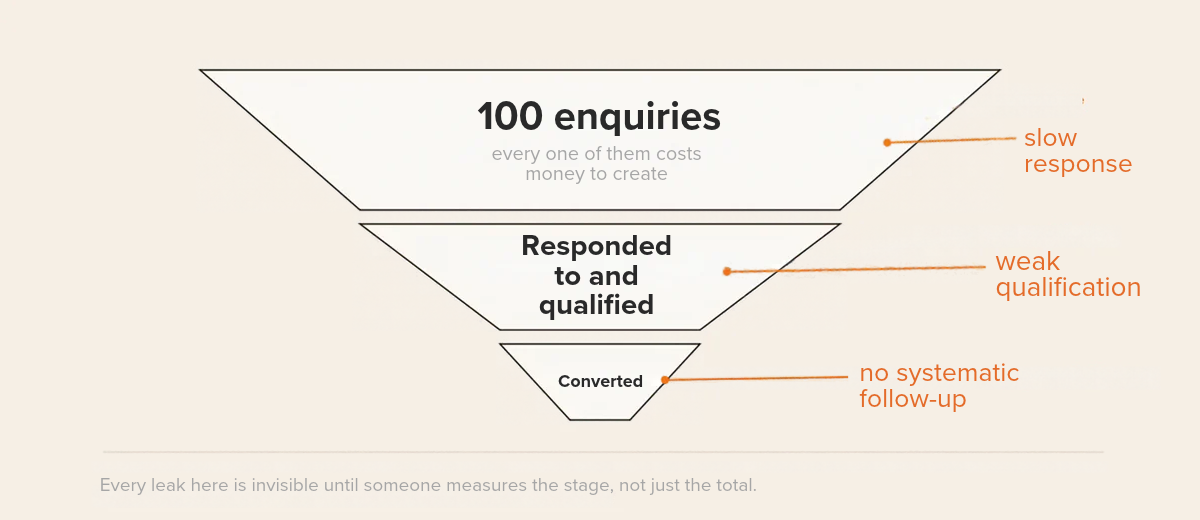
Imagine a business generating 100 enquiries a month. If response times are inconsistent, qualification is weak, follow-up depends on individual memory, proposals are generic, and dormant prospects are rarely nurtured — increasing enquiries to 200 does not automatically double growth. It may simply double the number of opportunities that are poorly handled.
This is why “we need more leads” can sometimes be an incomplete diagnosis. The more useful management question is: what happens from the moment somebody notices us to the moment they buy, and what happens after that?
- Does the market understand clearly what makes us relevant or different?
- Are we attracting the right enquiries, or simply more enquiries?
- How quickly and consistently are leads responded to?
- Is there a defined qualification and follow-up process?
- Does our CRM protect every opportunity, or merely store contact details?
- Do our content, PR, sales presentation and digital communication tell one coherent story?
- Can management see where prospects are progressing, slowing down, or disappearing?
If several of these questions produce uncomfortable answers, the next investment may not be another campaign. It may be fixing the system around the campaign — which is exactly what a Growth Readiness Diagnostic is built to surface.
Growth usually leaks between departments
Marketing may believe its job ends when the lead is generated. Sales may believe the leads are not good enough. The CRM may contain data but not drive action. Content may create engagement without building authority. PR may create visibility without being connected to search, landing pages, or sales conversations. Management may see reports from every function but still lack one view of the customer journey.
Individually, every team can appear busy. Collectively, the business can still underperform.
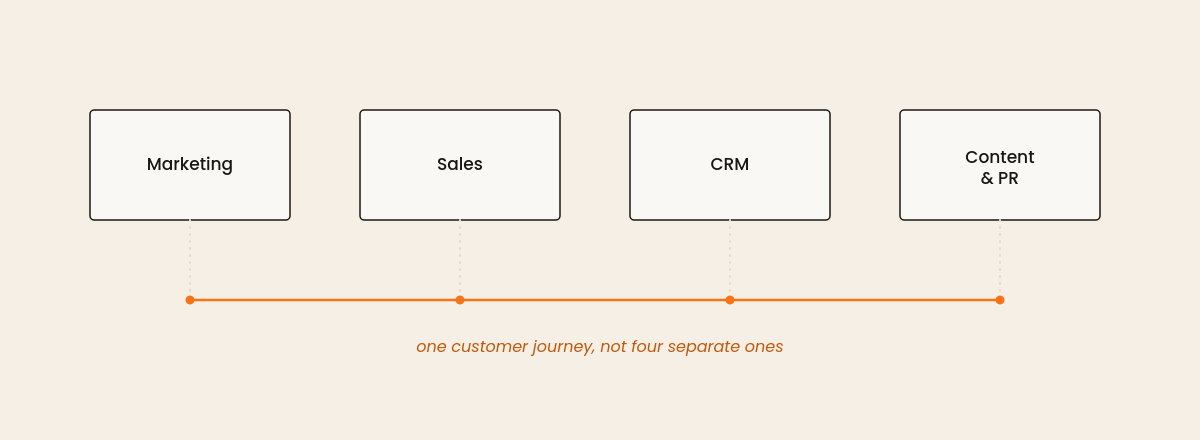
The leak often lives in the handover — attention to enquiry, enquiry to response, response to qualification, qualification to meeting, meeting to proposal, proposal to follow-up, and customer to repeat business or referral.
Growth becomes more predictable when these stages are designed as one journey rather than managed as unrelated activities.
More marketing works best when the rest of the system is ready for it
This is not an argument against marketing investment. Quite the opposite. Strong marketing deserves a business system capable of converting the attention it creates.
When positioning is clear, the right audience is being reached, the sales process is disciplined, follow-up is systematic, content builds authority, PR adds credibility, automation protects consistency, and management can see the numbers that matter — additional marketing has somewhere productive to go. Then media becomes an accelerator rather than a substitute for diagnosis.
A simple growth diagnostic for management
Before approving the next increase in marketing activity, management can ask six questions.
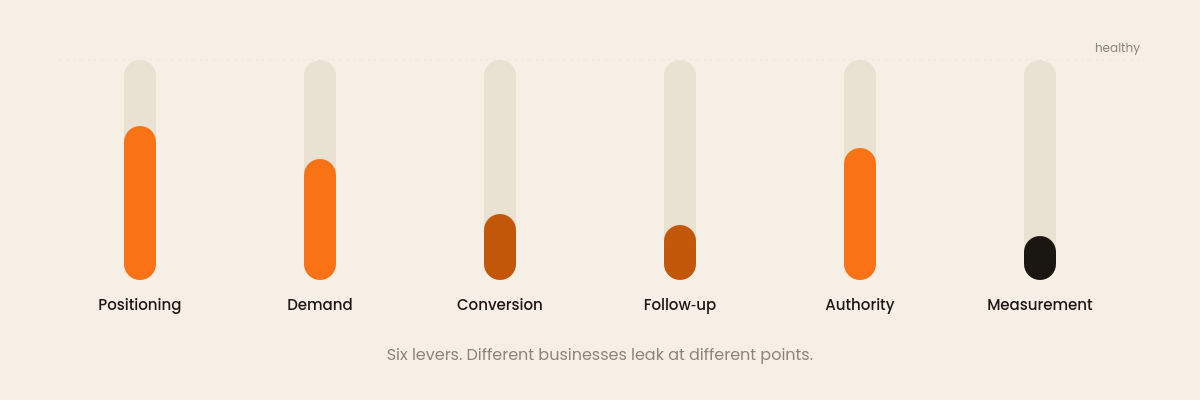
- Positioning. Can a prospect understand, quickly and clearly, why they should consider us?
- Demand. Are we consistently creating interest from the kind of companies or customers we actually want?
- Conversion. Do we know what percentage of enquiries become meaningful conversations, proposals and sales?
- Follow-up. Is follow-up systematic, useful and visible, or dependent on individual discipline?
- Authority. Does our market see us merely as another option, or as a credible expert worth shortlisting?
- Measurement. Can we identify where growth is slowing down without relying on assumptions?
The objective is not to score perfectly on every question. It is to identify which few gaps deserve attention first.
Diagnose first. Prescribe second.
At Young, this thinking is behind the development of Young Growth Systems (YGS). Over the years, our work has expanded across strategy, creative, digital, performance, video, PR, automation and sales enablement. The important lesson is that businesses rarely need every capability at once. They need the right intervention for the right growth problem.
That is why the starting point for YGS is not a service menu. It is a Growth Diagnostic.
The Diagnostic is designed to look across the growth journey and help identify where momentum may be getting lost — whether the issue sits in positioning, demand generation, conversion, follow-up, content, CRM, authority, automation, or measurement, because adding more activity before understanding the constraint can make growth more expensive without making it more predictable.
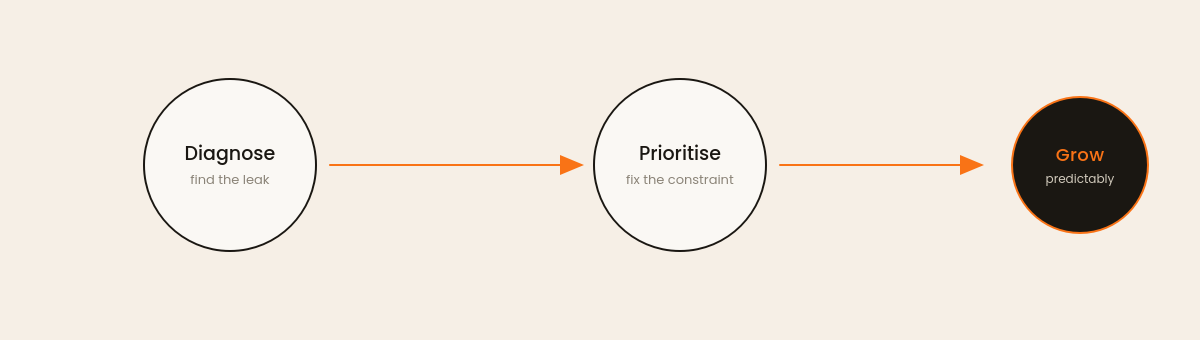
Before you spend more on growth, find out what is slowing it down.
Answer six questions. See where your growth system is actually leaking, before you spend another rupee finding out the hard way.